Data that matters
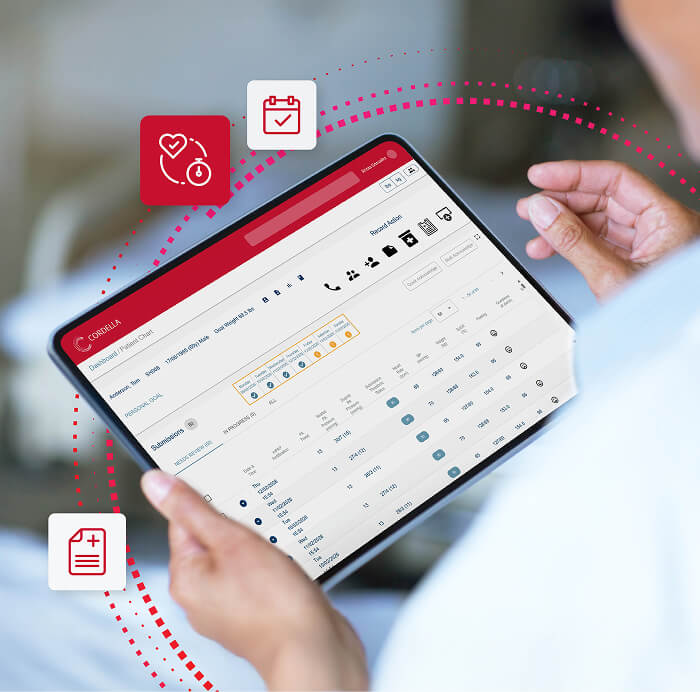

The next-generation sensor with a connected heart failure management platform that empowers patients and physicians to stay ahead and reduce hospitalizations.
Each heart failure hospital readmission is associated with increased risk of mortality.1-3 Early warning signals, such as pulmonary artery (PA) pressure, can allow clinicians to intervene and get ahead of heart failure setbacks.4-7





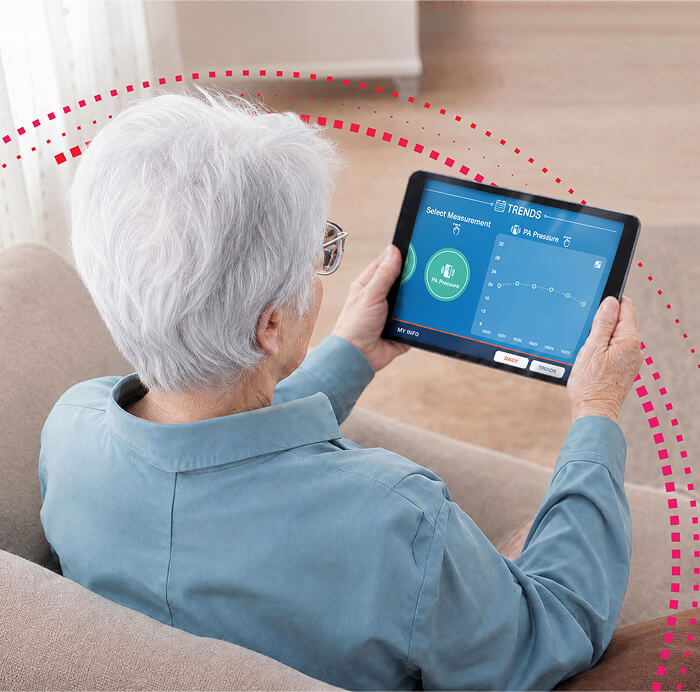
See how Cordella is helping patients like James live a better quality of life.
Cordella Pulmonary Artery Sensor System
Intended Use: The Cordella Pulmonary Artery Sensor System is intended to measure, record and transmit pulmonary artery pressure (PAP) data from NYHA Class III heart failure patients who are at home on diuretics and guideline-directed medical therapy (GDMT), as well as have been stable for 30 days on GDMT. The device output is meant to aid clinicians in the assessment and management of heart failure, with the goal of reducing heart failure hospitalizations.
Contraindications: The Cordella Pulmonary Artery Sensor System is contraindicated for patients with an inability to take dual antiplatelet or anticoagulants for one month post implant.
Clinical Considerations for Patient Selection: The following patients may not be appropriate for implantation of the Cordella PA Sensor System:
Warnings: The Cordella PA Sensor System is not intended for emergency use or real-time monitoring. Before use, thoroughly read and understand the instructions for use to avoid potential injury or death.
Warnings: Implant Procedure. The implant procedure must be performed by trained clinical personnel with appropriate interventional and endovascular skills, including implantable device placement and deployment over a guidewire, in a location with infrastructure to support right heart catheterizations. Fluoroscopy is required to visualize the target vasculature and ensure proper device placement. The Cordella Sensor and Delivery System are single use only; DO NOT reuse, reprocess, or re-sterilize. Use only the cables and accessories provided. DO NOT use the Delivery System if packaging or components are not sterile, opened, damaged, or expired, and do not attempt to repair, modify, disassemble, or otherwise alter the system. DO NOT expose the Cordella Sensor to therapeutic levels of ultrasonic energy.
The Cordella Sensor should be placed in the patient’s right pulmonary artery with diameter ≥12 mm and ≤26 mm at the right pulmonary artery downturn; placement outside this range or location may result in vessel injury or Sensor instability. Ensure that the guidewire is in the right pulmonary artery distal to the implant location and not in a side branch. Use caution to avoid dislodging or damaging previously implanted medical devices, including pacemaker and/or implanted cardiac defibrillator leads. Avoid contacting the Cordella Sensor with subsequent catheters or wires; when contact is unavoidable, take care to avoid disrupting the Sensor. Excessive force may result in vessel injury or perforation. DO NOT advance the Delivery System if excessive resistance is felt, and DO NOT advance or retract the Delivery System without a guidewire in place. Future RHCs require fluoroscopy to reduce catheter or guidewire contact with the Sensor and should be done via the left pulmonary artery. DO NOT pull the release wires before intended deployment, use an automated power injector through the Stability Sheath, or insert the Sensor without supporting it from behind. If gripping the Sensor is necessary, grab only by the sides and not the top surface. After the procedure, patients must adhere to prescribed anticoagulation, antiplatelet, and other medications.
Warnings: Reader and Docking Station. The Reader is suitable for home healthcare environments and professional healthcare facilities except near active heart failure hospital equipment and the radiofrequency (RF) shielded room of a medical electrical (ME) system for magnetic resonance imaging, where the intensity of electromagnetic (EM) disturbance is high. The Reader and Docking Station should not be used adjacent to or stacked with other equipment unless normal operation is verified. DO NOT expose any power accessories, the Reader, or the Docking Station to food or liquids. DO NOT use the reader or docking station near explosive or flammable anesthetic agents. DO NOT position power cables in any manner that may cause entanglement or strangulation or in a way that may cause tripping hazard. The patient should not have necklaces, jewelry, shirt pocket contents, metal objects, and near field communication objects in the vicinity of the reading location while taking a reading. If the skin becomes red, warm, or irritated, immediately stop using the Reader, contact Customer Service, and notify the patient’s primary care provider (PCP). Contact Customer Service if device damage is observed. Endotronix analyzes sensor performance over time. When the analysis suggests anomalous sensor performance, recalibration using an RHC procedure may be necessary. If anomalous data is confirmed via the internal monitoring program, Endotronix will notify the site.
Warnings: Calibration Equipment. CalEQ must be operated only by trained Endotronix personnel in an appropriate professional healthcare environment and sufficiently distant from electromagnetic disturbance environments, including RF-shielded MRI rooms. Avoid adjacent or stacked use unless normal operation is verified. Use only Endotronix-supplied accessories, cables, and components. Connect only to 60601-1 compliant patient monitors and supply mains with protective earth; do not plug additional devices into the CalEQ power strip.
Precautions: The implant procedure is an adjunct to a standard RHC procedure, and all standard RHC protocols should be followed. Only use the side-port of the Stability Sheath for injection and aspiration; the guidewire lumen should not be used for aspiration or injection after initial flushing. The Cordella Sensor and Delivery System are only compatible with a 14 French introducer or larger; use of a smaller introducer may damage the product and may prevent introduction. Peel away introducers are not recommended. Avoid torquing the Stability Sheath with the Torque Catheter removed, as this may kink the Stability Sheath and affect fluid-filled pressure measurement reliability. Take precautions to avoid damage to the fragile, all-glass Cordella Sensor before implantation; only remove it from packaging when ready to start the procedure, avoid shock or drop to the distal end, and limit contact before insertion. Avoid squeezing or pinching the Sensor body. DO NOT place more than one Cordella Sensor in a patient, as two Sensors may interfere with accurate readings. Improper or rapid removal of the Delivery System may cause vessel damage. Once inserted, it is recommended to periodically flush the Delivery System side port with heparinized saline (e.g., approximately every 10 minutes) to prevent clotting. If there is a concern for risk of clotting, the clinician may elect to administer a heparin bolus or infusion. In the PROACTIVE-HF trial, the protocol required a heparin drip with an ACT ≥ 200 sec. Explanting the Sensor after implantation is not recommended.
Activities that may expose the patient to ambient pressure extremes may affect device performance; contact Customer Service if the patient plans to SCUBA dive. Accuracy of the Cordella Pulmonary Artery Sensor System is slightly affected by large changes in elevation between the initial baseline calibration and subsequent measurements, and readings may lose accuracy when taken at >2000 m of elevation; contact Customer Service if a patient plans to travel or move to a location at >2000 m of elevation. Contact Customer Service if there is evidence of a change in device performance. The CalEQ should not be used in the sterile field. Do not expose myCordella components to water or liquids; contact Customer Service for replacement if exposed. Do not drop or use the Reader if damaged, if the battery is exposed, or if components or labeling are compromised. CalEQ and the Reader contain lithium-ion batteries. LVAD and Continuous Glucose Monitor compatibility has not been assessed.
Potential Adverse Events: Potential risks associated with the overall procedure include potential access complications associated with standard right heart catheterization, the potential risks of conscious sedation, and the use of angiography: Allergic reaction; Arrhythmias; Bleeding complications (which may require transfusion); Cardiac arrest; Chest pain; Death; Device embolization/migration; Device explant; Emergent or urgent cardiac, vascular, and/or other surgery necessitated by the device or implant procedure (e.g., coronary sinus lead revision); Endocarditis or device infection; Entry site complications (e.g., hematoma, dissection); Fracture of a component of the device/system that may or may not lead to serious injury or surgical intervention; Gastrointestinal bleed; Hemoptysis; Hypo or hypertension; Infection or fever; Lead dislodgement; Peripheral embolism/thrombus; Pulmonary embolism/pulmonary occlusion; Pseudoaneurysm of the vein; Radiation exposure; Reaction to contrast media/medication; Renal insufficiency or failure; Respiratory distress or failure (breathing problems); Right atrial/ventricular and coronary sinus lead dislodgement; Sepsis; Valvular injury (tricuspid and/or pulmonary); Vascular complications (e.g., venous dissection, perforation, rupture, arteriovenous fistula,); Vessel trauma which may require surgical repair; Worsening heart failure.
MRI Safety Information: The Cordella Pulmonary Artery Sensor is MR Conditional. A patient with the Cordella Sensor may be safely scanned under specific conditions; failure to follow these conditions may result in injury to the patient. See the Instructions for Use for complete MR Conditional scan conditions.
CAUTION: US law restricts this device to sale by or on the order of a physician. See Instructions for Use for full prescribing information.
PP-IHFM-US-0107 v1.0